The Profit That Disappears at Closing
I've watched this scenario unfold dozens of times. A seller lists their beachfront condo for $8,000,000 MXN, thrilled about the appreciation since they bought it years ago for $5,000,000 MXN. In their mind, they're pocketing $3,000,000 MXN in profit.
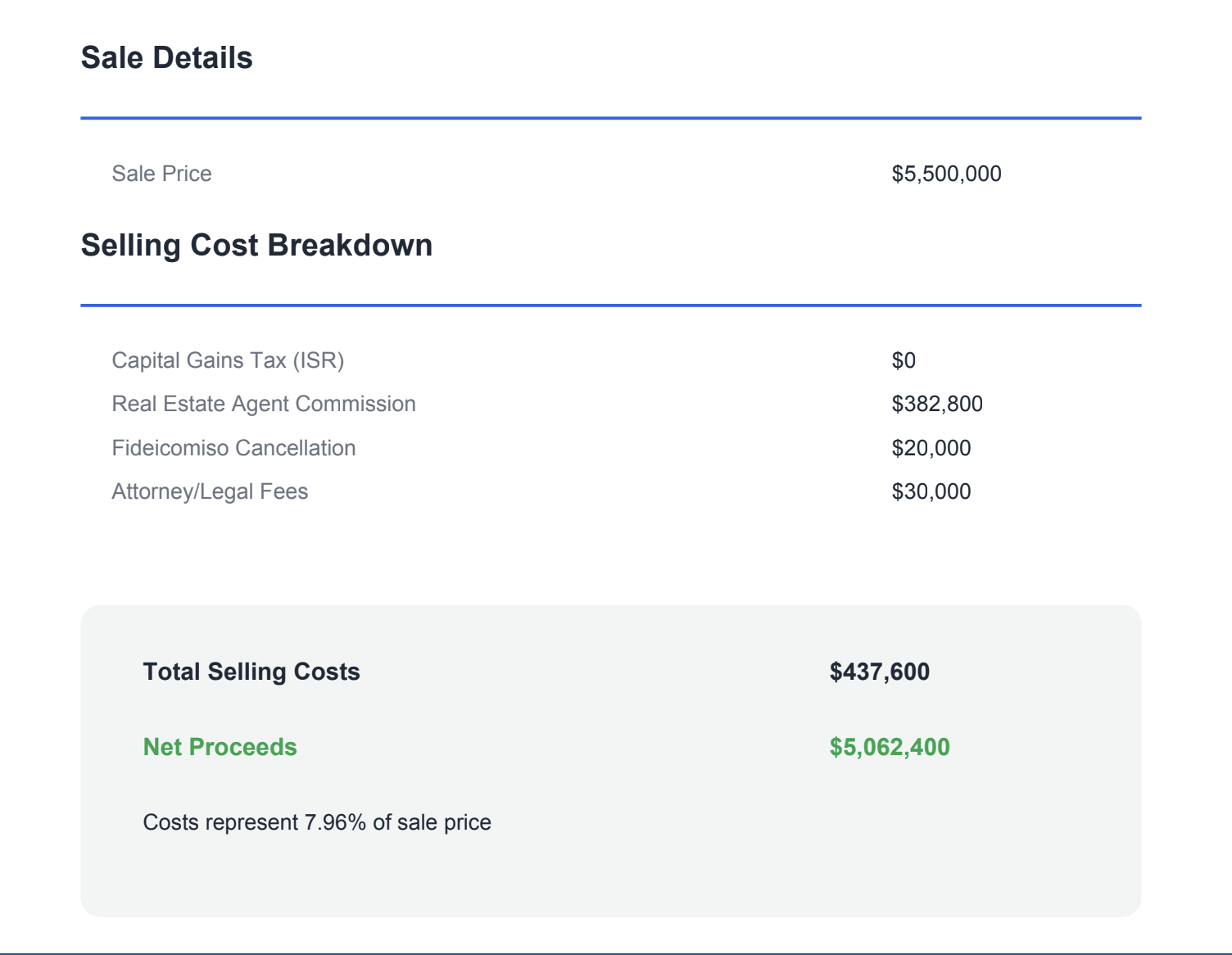
Then the notary runs the numbers at closing. Capital gains tax: $1,050,000 MXN. Agent commission: $556,800 MXN. Fideicomiso cancellation: $20,000 MXN. Attorney fees: $34,800 MXN. The seller's 'profit' of $3,000,000 shrinks to about $1,300,000—less than half of what they expected.
This isn't unusual. Selling costs in Mexico typically eat 10% to 25% of the sale price, with capital gains tax alone often exceeding 10% of your profit. If you don't plan for these costs upfront, you're negotiating blind and may accept offers that barely cover your expenses.
That's exactly why I built the Seller Cost Calculator. Input your sale price, purchase history, and a few key details, and you'll see a complete breakdown of every cost—plus the exact amount you'll walk away with. No math, no surprises, and no spreadsheets.
- Capital gains tax (ISR) can reach 35% of your profit for non-residents
- Agent commissions typically run 5-8% of sale price plus 16% IVA
- Residents may qualify for primary residence exemptions up to ~$5,500,000 MXN
- Fideicomiso holders pay cancellation fees when selling
- The calculator shows your estimated net proceeds after all costs
Why Selling Costs in Mexico Are So High
Before diving into the calculator, let's understand why selling property in Mexico is expensive—and what you can legally do to reduce these costs.
The biggest hit is the ISR (Impuesto Sobre la Renta), Mexico's capital gains tax on real estate. Unlike many countries that offer preferential rates for long-term holdings, Mexico taxes property gains at income tax rates—up to 35% for high gains. For non-residents, it's a flat 35% on the net gain with no exemptions.
For residents with an RFC (Mexican tax ID), there's a crucial exemption: if you're selling your primary residence, you can exclude up to approximately 700,000 UDIs (around $5,500,000 MXN) from capital gains tax. This one provision can save you over $1,000,000 MXN in taxes—but you must qualify.
Then there are agent commissions. In Mexico, sellers typically pay the full commission (buyers rarely pay agents directly). Standard rates range from 5% to 8% of the sale price, and 16% IVA is added on top. On a $5,000,000 MXN sale with a 6% commission, you're looking at $348,000 MXN in agent fees alone.
Finally, if you're a foreign seller who holds property through a fideicomiso (bank trust), the trustee bank charges a cancellation fee—typically $15,000 to $25,000 MXN—to release the title for transfer.
Capital Gains Tax (Residents)
10%–35% of taxable gain
Capital Gains Tax (Non-Residents)
Flat 35% of gain
Agent Commission + IVA
5.8%–9.3% of sale price
Fideicomiso Cancellation
$15,000–25,000 MXN
Step 1: Select Your Residency Status
Open the Seller Cost Calculator and start by indicating whether you're a Mexican tax resident or a non-resident.
This isn't about citizenship—it's about your fiscal status with SAT (Mexico's tax authority). If you have an RFC (Registro Federal de Contribuyentes) and CURP, and you're registered as a tax resident, select 'Resident.' Otherwise, select 'Non-resident.'
This selection dramatically changes your tax calculation. Residents use a progressive rate system (10% to 35%) and can claim deductions and exemptions. Non-residents pay a flat 35% on the net gain with no exemptions—period.
If you're unsure of your status, consult a Mexican tax accountant before selling. Converting to resident status before the sale (if you qualify) could save you hundreds of thousands of pesos.
- Residents: Have RFC + CURP, use progressive tax rates, can claim exemptions
- Non-residents: Flat 35% tax on gain, no primary residence exemption
- Residency status is about fiscal registration, not citizenship or visa type
- Consider consulting a tax advisor if your status is unclear
Step 2: Enter Your Expected Sale Price
Enter the price you expect to sell for in Mexican pesos (MXN). This is the amount that will appear on the escritura (deed) at closing.
The calculator uses this as the base for percentage-based costs like agent commissions. It's also used to calculate what percentage of the sale price goes to costs versus your pocket.
Pro tip: If you're still deciding on a listing price, run the calculator at multiple price points. Seeing the net proceeds at $7,000,000 vs $7,500,000 helps you understand whether aggressive pricing is worth it—or if you should price higher to account for negotiation room.
Remember: The notary will calculate taxes based on the official sale price on the deed. Underreporting the price is illegal and carries serious penalties. Use the actual expected sale price.
Step 3: Enter Your Cost Basis and Deductions
This is where careful record-keeping pays off. The calculator asks for three key amounts that reduce your taxable gain.
Original Purchase Price: What you paid when you acquired the property. This should match the price on your original escritura. If you can't find it, your notary or the Public Registry can provide a copy.
Capital Improvements (with facturas): Permanent improvements you made to the property—renovations, additions, major repairs, infrastructure upgrades. CRITICAL: Only improvements with official facturas (Mexican invoices with RFC) are deductible. That cash renovation you paid without a factura? It doesn't count, legally.
Allowable Closing Deductions: Expenses from your original purchase that can be deducted—notary fees, legal fees, ISAI tax you paid as the buyer. These are typically available from your closing documents when you bought.
The more you can document, the lower your taxable gain. Sellers who kept facturas for renovations often save 10-15% on their tax bill compared to those who can only prove the original purchase price.
- Original purchase price: From your escritura when you bought
- Capital improvements: Only deductible WITH facturas (official invoices)
- Closing deductions: Notary fees, legal fees, ISAI from your purchase
- Documenting more deductions = lower taxable gain = lower tax
Step 4: Apply the Primary Residence Exemption (If You Qualify)
For residents, this is potentially your biggest tax break. Mexican law allows you to exclude up to approximately 700,000 UDIs (roughly $5,500,000 MXN) from capital gains when selling your primary residence.
To qualify, you must meet ALL of these criteria: You have an RFC and CURP. You've used the property as your primary residence (not an investment or rental). You haven't claimed this exemption in the past 3 years.
If you qualify, check the 'Apply exemption' box and enter the exemption amount. The calculator defaults to $5,500,000 MXN, but you can adjust it based on current UDI values or your accountant's guidance.
On a property where your gain is $4,000,000 MXN, the exemption wipes out the entire gain—zero capital gains tax. On a gain of $7,000,000 MXN, only $1,500,000 is taxable after the exemption. This single checkbox can save you over $1,000,000 MXN.
Note: Non-residents cannot claim this exemption regardless of how they used the property. If you're selling your vacation home in Cancún and you're not a Mexican tax resident, the full gain is taxable at 35%.
Primary Residence Exemption
Up to ~$5,500,000 MXN
Cooldown Period
3 years between claims
Eligibility
Residents with RFC/CURP only
Understanding the Capital Gains Tax Calculation
Once you've entered your sale price, cost basis, and exemptions, the calculator computes your taxable gain and estimates the ISR (capital gains tax) due.
Taxable Gain = Sale Price – Original Purchase Price – Capital Improvements – Allowable Deductions – Primary Residence Exemption (if applicable). Only positive gains are taxed—if you're selling at a loss, there's no capital gains tax.
For residents, the tax uses a progressive rate system. The first $250,000 MXN of gain is taxed at your specified rate (default 35%). Amounts above that are taxed at the maximum 35% rate. This is a simplified estimate—your actual tax calculation by the notary may differ based on inflation adjustments and other factors.
For non-residents, it's simpler but more painful: flat 35% on the entire gain, no deductions, no exemptions.
The calculator shows both the taxable gain and the estimated ISR due, so you know exactly how much of your profit goes to SAT.
Step 5: Configure Agent Commission
Real estate agent commissions in Mexico are typically paid by the seller. The calculator lets you estimate this cost based on the commission rate.
Standard rates range from 5% to 8%, with 6% being most common for residential properties. Luxury properties and difficult-to-sell listings may command higher rates; FSBO-assisted services may charge less.
Important: The calculator automatically adds 16% IVA (Mexico's value-added tax) on top of the commission. So a 6% commission actually costs you 6.96% of the sale price. On a $5,000,000 MXN sale, that's $348,000 MXN—not $300,000.
If you're selling without an agent (FSBO), uncheck 'Include in calculation' to remove this cost from your estimate. But consider that properties sold without agents often take longer to sell and may sell for less than market value.
Pro tip: Commissions are negotiable. If you have a desirable property in a hot market, you may be able to negotiate a lower rate—especially if the same agent is helping you buy your next property.
Typical Commission Rate
5%–8% of sale price
IVA on Commission
16% (added on top)
Effective Rate (6% + IVA)
6.96% of sale price
Step 6: Add Legal and Professional Fees
While the buyer typically pays the notary and most closing costs, sellers often engage their own professionals—and these costs add up.
Legal or Closing Advisor: An attorney who reviews the sale contract, advises on negotiations, ensures you're not signing away more than you should, and oversees the transaction from your perspective. Fees typically range from $20,000 to $50,000 MXN, plus 16% IVA.
Check 'Include in calculation' if you plan to hire an attorney. While not legally required, independent legal advice is particularly valuable if you're selling to a developer, dealing with a complicated title situation, or unfamiliar with Mexican real estate law.
The calculator applies the 16% IVA to legal fees automatically, showing you the true out-of-pocket cost.
Create a free account to unlock this guide
Create a complimentary PropTrenz account to unlock premium due diligence guides.
Get Started
Create Account
Already Have Account