The $3,000,000 Question: Will This Property Make Money?
Here's a story I hear constantly. An investor finds a beautiful $3,500,000 MXN condo in Playa del Carmen. The listing says 'Great rental potential!' The investor does some quick math—$30,000/month rent times 12 equals $360,000 per year. That's over 10% return! They buy immediately.
Six months later, reality hits. After property management fees, maintenance, taxes, insurance, and three weeks of vacancy, their 'guaranteed' $360,000 has shrunk to $180,000. Add in the $450,000 they spent on closing costs and furnishing, and their actual cash-on-cash return is barely 4%. They could have done better in a savings account.
The problem wasn't the property—it was the analysis. 'Gross rent' is meaningless. What matters is cash flow after all expenses, and ROI relative to what you actually invested. Without proper analysis, you're gambling, not investing.
That's exactly why I built the ROI Calculator. Input your purchase details, financing terms, expected rent, and operating expenses, and you'll see the numbers that actually matter: Net Operating Income, Annual Cash Flow, Cap Rate, Cash-on-Cash Return, and Total ROI including appreciation. No spreadsheets required.
- See true cash flow after ALL expenses, not just gross rent
- Compare cash purchase vs. financing scenarios instantly
- Calculate professional metrics: Cap Rate, Cash-on-Cash, Total ROI
- Model different rent levels, occupancy rates, and expense assumptions
- Download PDF reports to compare multiple properties
The Five Numbers Every Investor Must Know
Before diving into the calculator, let's understand the metrics it produces. These aren't arbitrary—they're the same metrics professional real estate investors use worldwide.
Net Operating Income (NOI): Your annual rental income minus all operating expenses (not including mortgage payments). This tells you how much the property earns from operations alone. It's the foundation for every other calculation.
Cap Rate (Capitalization Rate): NOI divided by the purchase price. This measures the property's income-generating power regardless of how you finance it. A 6% cap rate means the property generates 6% of its purchase price in operating income each year. Higher cap rates = better income potential, but often come with more risk.
Cash-on-Cash Return: Annual cash flow divided by the total cash you invested. Unlike cap rate, this accounts for financing. A leveraged purchase with 30% down might have a higher cash-on-cash return than a cash purchase, because you're earning returns on borrowed money.
Total ROI: Combines cash flow returns with property appreciation. Even a property with negative cash flow might have positive total ROI if it appreciates significantly. This gives the complete picture.
Annual Cash Flow: The actual money hitting your bank account each year after all expenses AND debt service. This is what you can spend or reinvest. Negative cash flow means you're subsidizing the property from your pocket.
Good Cap Rate (Mexico)
5%–8%
Good Cash-on-Cash
8%–15%
Positive Cash Flow Threshold
> $0
Strong Total ROI
12%–20%
Step 1: Enter Purchase and Renovation Costs
Open the ROI Calculator and start with your upfront investment.
Purchase Price: The agreed price for the property in Mexican pesos. This is straightforward—it's what you'll pay the seller.
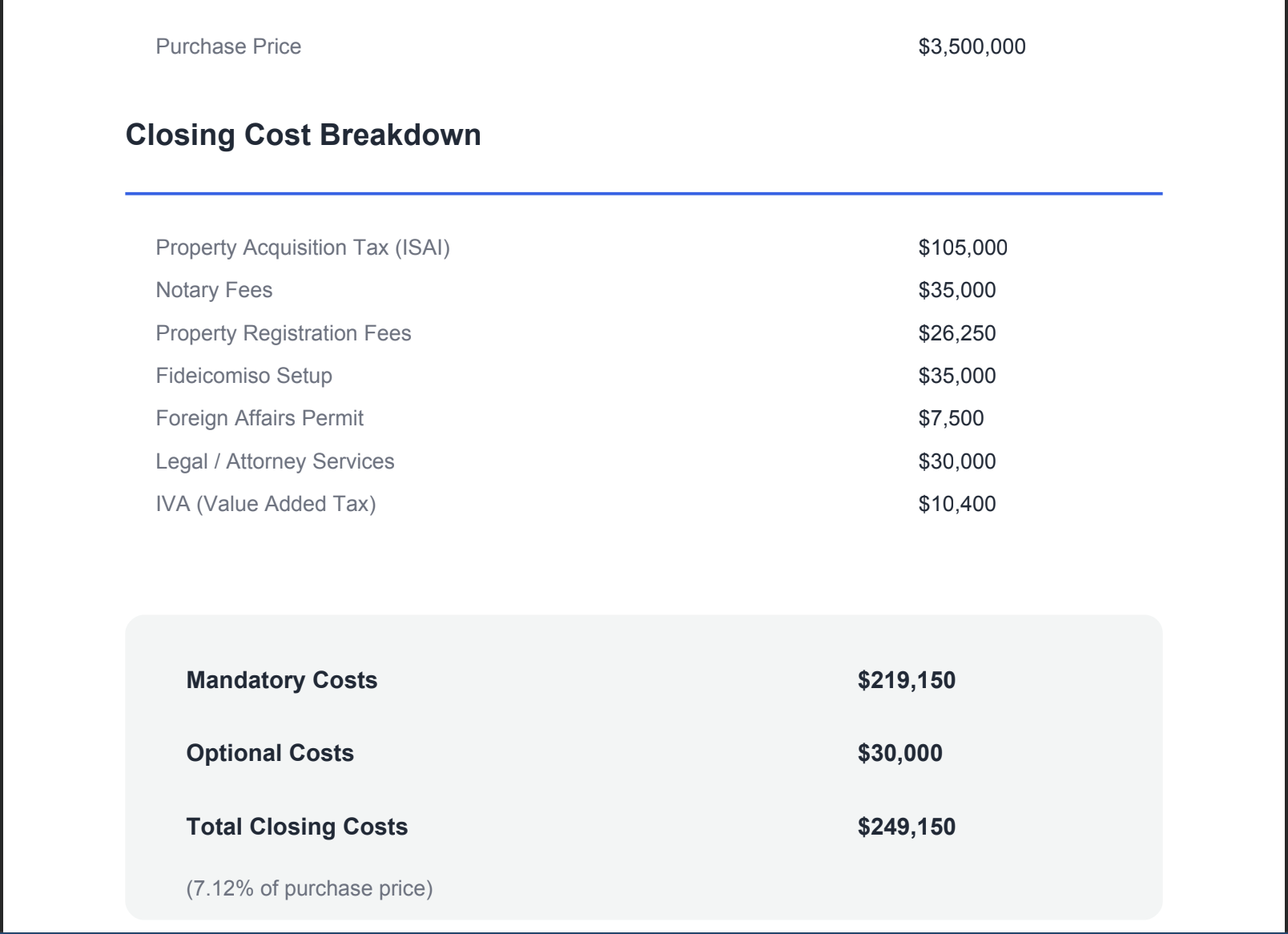
Closing Costs: Enter as a percentage of the purchase price. In Mexico, buyer closing costs typically range from 5% to 8% depending on location and whether you need a fideicomiso. Use PropTrenz's Closing Cost Calculator if you need a detailed breakdown.
Upfront Improvements: Any renovation or furnishing costs before you can rent. This is critical for short-term rentals—you might need $200,000+ to furnish a property for Airbnb. For long-term unfurnished rentals, this might be minimal.
The calculator sums these to show your Total Cash Invested (for cash purchases) or adds them to your down payment (for financed purchases). This is your true investment basis for calculating returns.
- Purchase price: The negotiated price in MXN
- Closing costs: 5%–8% of purchase price typically
- Upfront improvements: Renovations and furnishing before renting
- Don't forget: Closing costs significantly impact total investment
Step 2: Configure Financing (Or Skip for Cash Purchase)
The financing section lets you model different leverage scenarios. This is where the calculator becomes powerful for comparing strategies.
For a cash purchase, simply leave the down payment field empty or at 0%. The calculator assumes you're paying the full purchase price in cash, and your debt service will be $0.
For a financed purchase, enter your down payment percentage (typically 20-50% in Mexico for investment properties), the annual interest rate, and the loan term in years.
The calculator then computes your monthly and annual debt service (mortgage payments) and adjusts your cash-on-cash return accordingly. Leverage amplifies returns—both up and down.
Pro tip: Run the same property with different financing scenarios. You might find that 30% down gives you the best cash-on-cash return, while 50% down gives the best cash flow security. The right choice depends on your risk tolerance and goals.
Typical Down Payment
20%–50%
Mexico Mortgage Rates
8%–12% annual
Common Loan Terms
15–20 years
Step 3: Project Rental Income
Now for the revenue side. Be realistic here—overly optimistic rent projections are the #1 reason investor returns disappoint.
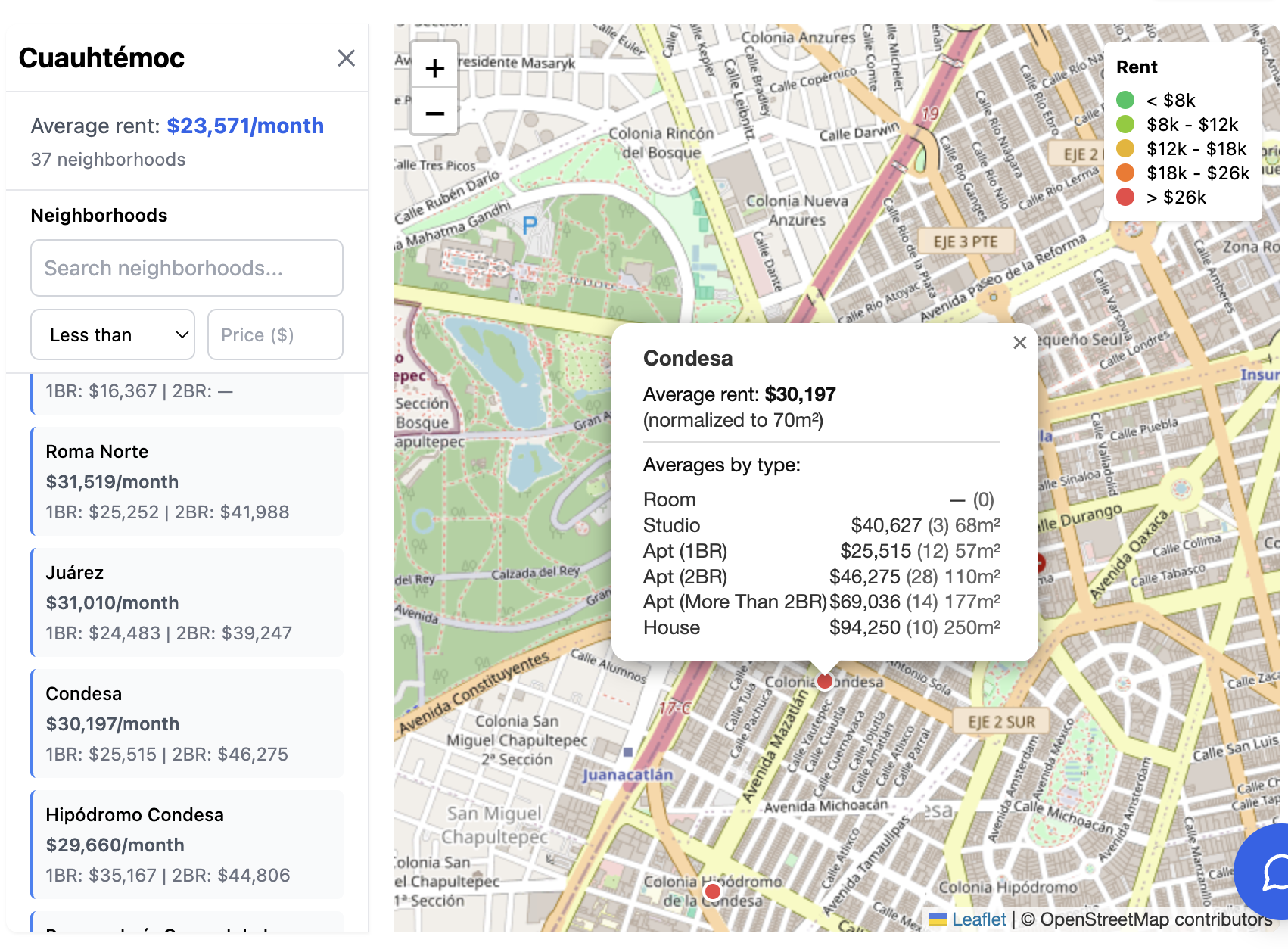
Monthly Rent: Your expected gross monthly rental income. For long-term rentals, this is straightforward. For short-term/Airbnb, estimate your average monthly income after seasonal fluctuations. Use PropTrenz's Rent Map to see actual rental prices in your target neighborhood.
Other Monthly Income: Additional revenue streams like parking fees, storage rental, or premium services. For most properties this is minimal, but it can add up for buildings with multiple income sources.
Occupancy Rate: The percentage of time the property will be rented. Default is 100%, but be realistic. Long-term rentals might achieve 95% (accounting for turnover). Short-term rentals in seasonal markets might average 70-80%. This single assumption dramatically affects your returns.
The calculator multiplies (Monthly Rent + Other Income) × 12 × Occupancy Rate to get your Annual Gross Income. This is the starting point for calculating NOI and cash flow.
- Research comparable rents using PropTrenz Rent Map
- For Airbnb, use average monthly income across seasons
- Be conservative on occupancy—assume 85-95% for long-term, 70-80% for short-term
- Other income can include parking, storage, or services
Step 4: Model Operating Expenses
This is where most amateur investors underestimate costs. The calculator separates expenses into percentage-based and fixed annual costs.
Operating Expenses (%): A percentage of gross income for variable costs—maintenance, repairs, utilities you cover, cleaning between tenants, supplies, and general upkeep. For long-term rentals, 15-25% is typical. For short-term rentals with higher turnover and cleaning costs, budget 25-40%.
Property Management (%): If you're not self-managing, budget 6-10% of gross income for a management company. They handle tenant screening, rent collection, maintenance coordination, and emergencies. Even if you self-manage, consider adding 5% for your time.
Annual Property Taxes: The predial (property tax) paid to the municipality. In Mexico this is remarkably low—typically 0.1% to 0.5% of assessed value. Check with the seller or municipality for exact amounts.
Annual Insurance: Property insurance covering fire, theft, liability, and natural disasters. Costs vary by location and coverage, but budget $10,000-30,000 MXN annually for typical condos.
Other Annual Expenses: Fideicomiso fees (if foreign owner), HOA special assessments, accounting services, or any other recurring costs. Don't forget fideicomiso maintenance—typically $8,000-15,000 MXN per year.
Operating Expenses
20%–35% of gross income
Property Management
6%–10% of gross income
Property Taxes (Predial)
0.1%–0.5% of value
Annual Insurance
$10,000–30,000 MXN
Step 5: Add Appreciation Assumptions
The final input is expected annual appreciation—the percentage you expect the property value to increase each year.
This is speculative, but important for total return analysis. Historical appreciation in Mexico varies dramatically by location. Prime areas in Mexico City have seen 5-8% annual appreciation. Beach markets have been more volatile—some areas seeing 10%+ during booms, others flat or declining.
The calculator uses this to compute Total ROI, which combines your annual cash flow return with appreciation gains. A property with 2% cash-on-cash but 8% appreciation might have 10% total ROI—not bad, but you're banking on appreciation rather than income.
Conservative recommendation: Use 3-5% for stable urban markets, 0-3% for speculative or volatile markets. If your investment only makes sense with aggressive appreciation assumptions, you're speculating, not investing.
Remember: Appreciation gains are unrealized until you sell. Cash flow is money in your pocket every year.
Reading the ROI Summary
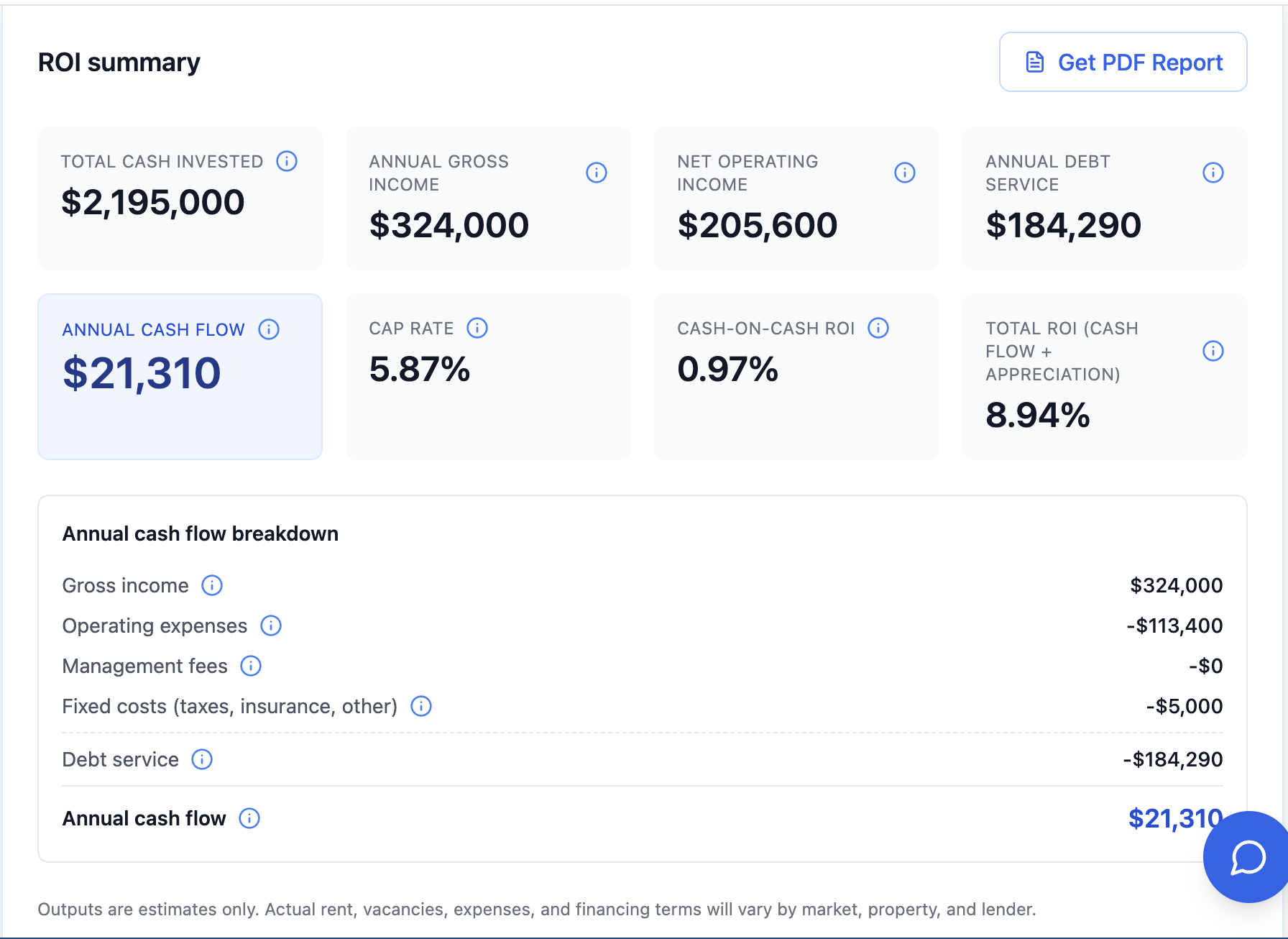
Once you've entered all inputs, the summary section shows everything you need to evaluate the investment.
Total Cash Invested: Your true investment basis—down payment (or full price for cash) plus closing costs plus renovations. This is what you're putting at risk.
Annual Gross Income: Total rental revenue adjusted for occupancy. If this seems low, check your occupancy rate assumption.
Net Operating Income (NOI): Gross income minus all operating expenses. This is the property's pure earning power before financing.
Annual Debt Service: Your mortgage payments if financing. $0 for cash purchases.
Annual Cash Flow: The money you actually keep—NOI minus debt service. Positive is good. Negative means you're subsidizing the property.
Cap Rate, Cash-on-Cash, and Total ROI: The professional metrics that let you compare this property to any other investment opportunity.
The Cash Flow Breakdown
Below the summary metrics, the calculator shows a detailed breakdown of how your cash flow is computed. This is invaluable for identifying where your money goes.
You'll see: Gross Income → minus Operating Expenses → minus Management Fees → minus Fixed Costs → equals NOI → minus Debt Service → equals Cash Flow.
Use this to stress-test your assumptions. What if operating expenses are 30% instead of 20%? What if occupancy drops to 80%? Change the inputs and watch how cash flow responds.
This breakdown also helps you identify optimization opportunities. If management fees are eating your returns, maybe self-management makes sense. If fixed costs are high, shop for better insurance rates.
The goal is to understand your investment inside and out before you write a check.
Create a free account to unlock this guide
Create a complimentary PropTrenz account to unlock premium due diligence guides.
Get Started
Create Account
Already Have Account